Towns & Villages in Antibes — 16 of Our Favourites

Discover the top Antibes towns and villages

Explore some of the loveliest towns and villages around Antibes.

Find loads of top tips and local insights in our Antibes Destinations Guide.

a village on a hill top near Nice

1. Saint-Paul de Vence, Alpes-Maritimes

Location
Vence

Saint-Paul de Vence is known for being an art mecca, hundreds of galleries and workshops tucked amongst the tiny old streets of a perfectly preserved medieval village.

The lanes are full of art galleries, gift shops and chic cafés. Sculptures appear around every turn and many charming fountains can be found in nooks and crannies around the village. Many of these artists live in the surrounding area and have workshops and studios which provide a wealth of art in all different styles - modern, abstract and figurative. Other crafts made locally include woodwork, weaving and ceramics, all of which can be bought in the village boutiques.

At the entrance to the village is a large square lined with olive trees where locals gather daily to play boules and sip pastis. They are well-used to being gawped at and photographed and are usually happy to explain the game to you, even happier if you buy them a drink to say thank you. There is a friendly bar with a long terrace that runs the length of the square where you can relax and watch the daily life of Saint Paul de Vence go by.

Although definitely a “must-see”, Saint Paul de Vence suffers from being on everyone's list of places to see and so it's swarming with people throughout the year, try to avoid peak tourist season if possible. The tourist office provides guided tours in many languages during the summer.

Valbonne, grid pattern streets

2. Valbonne, Alpes-Maritimes

Situated along the Brague river, the town consists of two separate areas - the old town/village and the technology park of Sophia Antipolis.

The town was built in 1519, based on a grid Roman street plan - a refreshing change from the dark winding streets of many other Provençal villages. As with many towns along the Côte d'Azur excavations carried out in the surrounding hills bear witness to the presence of man going back an extremely long way, even to prehistoric times. While it has quite a lot of boutiques and chic cafes to keep the tourists and resident Brits occupied, it has the feel of a living village rather than being a tourist attraction.

The village is a charming 16th century village of cobbled streets, pastel buildings, colourful shutters and antique markets, all set up around a simply gorgeous central square filled with café tables in the sun. In extreme contrast the neighbouring technology park of Sophia Antipolis, built in the 1970's, has evolved into a highly recognised international community, with more than 1,000 companies hiring more than 25,000 people and specialising in research and development.

Villeneuve Loubet

3. Villeneuve Loubet

Situated between Nice and Cannes, Villeneuve Loubet is a delightful area split into two parts - a seaside resort with plenty of outdoor activities and a fascinating old town.

The best way to discover the old village is to take a bus or leave your car in the large “Plans” car park and walk along the river.

Starting at the mouth of the Loup (meaning “wolf”) river it's a short stroll to the old town of Villeneuve-Loubet. It's interlaced with pretty lanes which open up into characterful squares with art galleries and cafés.

There is a 13th century castle with a cobbled courtyard, ramparts and walls to explore. The village itself was rebuilt in the 16th century and has many beautiful examples of Renaissance architecture, as well as a Museum of Art and History. Guided tours are organised by the tourist office, call in to ask for details. It provides a welcome respite from the busy coastal resorts.

The beach resort of Villeneuve Loubet Plage is dominated by the purpose built, 1,000 bed apartment block which is supposed to resemble three large white waves rolling in from the sea. At 70m high, they dominate the horizon and certainly draw your attention. Whilst they may not be to everyone's taste, the architect has created that rare apartment block where every flat has a terrace and a view.

image of fishing boats

4. Cap d'Antibes

Location
Antibes

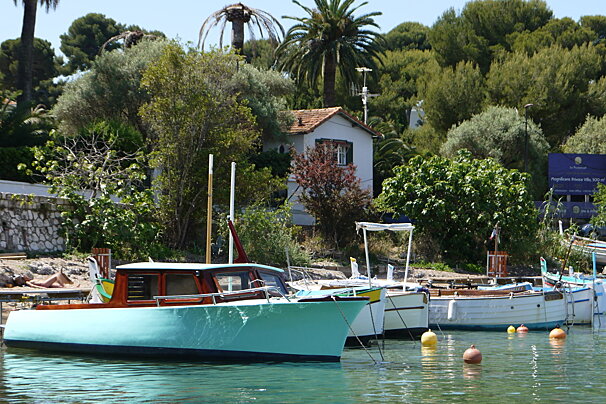
A short walk from both Antibes and Juan-les-Pins is the Cap d'Antibes. This gorgeous headland is gently undulating and is filled with smart and very private villas. The Cap is best known for the uber-luxurious (and expensive) Hotel du Cap Eden Roc.

This area has many celebrity visitors, especially around the time of the Cannes Film Festival, soaking up fantastic views that can be had from the hills and the rocky coastline that is filled with private coves

Small harbours are home to colourful boats, the waters are crystal clear and pine trees gracefully line the coast. You can follow a coastal path around the peninsula, it will take you an hour or two.

a view over the monastery on ile de saint honorat

5. Ile de Saint Honorat, Lerins Islands

Location
Saint Tropez

The island of Saint Honorat is the smaller of the two inhabited Lerins islands. Its main attraction is the monastery, a wonderful stone building well worth a visit.

This island is less touristy than its neighbour Sainte Marguerite. The only occupants are monks that have lived on the island since the 5th century in their very own medieval abbey.

Only 15 minutes by boat, this is a pleasant place to explore and walk to around the pine forest or have a swim in the clear blue water.

Ile Sainte Marguerite Beach, Cannes

6. Ile Sainte Marguerite

Location
Cannes

The gorgeous island of Saint Marguerite is the largest of the islands off the coast of Cannes. Regular ferries run from Cannes and only take around 15 minutes, yet this small island made up of a quiet pine forest and pretty coves feels far separated from the glitzy boutiques and hotels of Cannes.

Covered with pine and eucalyptus forest and edged with beautiful coves, this is an island to enjoy nature. The waters are crystal clear, with stunning views back to the Riviera coastline. There are only about 20 houses on the island in a small village near the ferry dock; the rest of the island is covered in forest, with an old fort and museum where you can explore the island's Roman and Crusader history, as well as its final days as a notorious French prison and soldier's hospital. The are a couple of restaurants for refreshments, and daily ferries provide access.

Displays of art on every street

7. Mougins, Alpes-Maritimes

Location
Mougins

Mougins covers a large swathe of hillside above Cannes, and this is where the smart money lives - luxurious villas and exquisite gardens dot the landscape, just close enough to enjoy Cannes, but far enough away to avoid the craziness.

The old town (veille ville) is where you should head on a day trip.

Park up and wander into the medieval village. The town is smothered in jasmine, its fragrance is heady on balmy summer nights.

Mougins is totally pedestrianised and is a joy to explore with fountains and sculptures adorning the streets and the plentiful art exhibitions are guaranteed to keep the casual browser enthralled. You can happily wander through the pretty little lanes, and admire the well kept houses and gardens before choosing one of the many restaurants for a long leisurely lunch. Remember to book ahead in the summer months to ensure a table on the terraces.

a wavey staircase outside a house in biot

8. Biot

Location
Biot

Biot is a lovely picturesque old town located up in the hills of Antibes. This medieval town is full of culture, history and art.

Founded by Celts, invaded by Romans, taken over by pirates, ruled by medieval knights and ravaged by the Black Death: the old town of Biot has a rich history spanning over 2,000 years.

Today, Biot is a charming town famous for its glassblowing, ceramics and pottery, as well as its shady cafés, jumble of medieval buildings and pretty hilltop views across the French Riviera. The village has the feel of an artist's colony, with lots of open workshops where you can go in and watch artistes create their pieces. Or just stroll through cobbled streets framed by stone archways and glimpses of the sea.

Lovely French bistros and restaurants line the old town and bars welcome guests in to try the local Provençal wines. Craft shops and galleries invite you to explore their produce and the historical stone buildings demonstrate the history and past of this village.

Biot has so much to explore, from the museums and galleries to the shops and workshops, you can spend days discovering and enjoying all that it has to offer. Being so conveniently located to the coast it makes for a wonderful place to stay or visit whilst on holiday in Antibes.

a photo of a perfume shop

9. Gourdon, Alpes-Maritimes

One of the most dramatic villages in Provence, Gourdon is situated on top of a rock, overlooking the Vallée du Loup. The views of the valley, all the way to the Mediterranean, are outstanding - you can see Nice and Théuole on a good day.

The Riviera seems like a million miles away in this natural paradise. The Gorge du Loup provides a spectacular back drop to the winding road that takes you up to Gourdon. If you're driving to Gourdon, you need to park at the bottom of the hill and walk up to the pedestrianised village.

Gourdon is fairly typical of the pretty 'perched villages' of Provence, with its well preserved stone houses, gift shops, art galleries and local crafts on sale. Pottery, perfumes and glassware shops make for interesting gift and souvenir shopping. The little lanes and alleys are fun to wander through (it won't take you long) and the kids will love the plentiful sweet shops.

Lots of yachts moored in St Laurent du Var

10. Saint Laurent du Var

Just the other side of the airport to Nice, Saint-Laurent-du-Var has been brought bang up to date in recent years. 

The waterfront is the place to be - a long esplanade stretches the length of the beach and is lined with a good choice of restaurants and bars. Most nightlife is centred around the harbour, where you’ll find more bars and restaurants as well as a couple of nightclubs. 

The centre of Saint-Laurent-du-Var is typical of a small but busy town; unremarkable but it has everything you need such as pharmacies, supermarkets, shops, etc. Cut through some of the smaller side streets and you’ll find yourself in what remains of the old town; Place Adrien Castillon is a charming little square with an 11th century church.

Just beyond the church is the “Hotel de Ville”, or town hall - an extremely grand building set in pleasantly shaded landscaped gardens. There's a children’s playground nearby and a number of boules pitches, as well as a theatre.

looking down over the rooves of a town near the sea in Nice

11. Cagnes Sur Mer

Haut Cagnes is the perched medieval village that overlooks the resort, and is home to the famous Renoir House and the Grimaldi Castle, two of the area’s most popular attractions.

Cagnes-sur-Mer is the largest suburb of Nice and is 15km west of the city, right on the seafront. The town is split into two districts, Cros de Cagnes and Haut Cagnes.

Cros de Cagnes is where you’ll find the beach-life; 3.5km of pebble shore with calm water, beach-clubs, shops, watersports, restaurants and a traditional fishing port - have a look at our beach section to find out more.

A wide promenade with a cycle lane runs alongside the beach, allowing you walk or ride the length of it and enjoy the many events and festivals that take place there throughout the year. Cros de Cagnes is also the home of the Hippodrome de la Côte d'Azur, a horse racing stadium and events venue, which you can find further along the coastline towards Villeneuve-Loubet.

High above Cros de Cagnes is the medieval village of Haut de Cagnes, an ancient settlement that is still inhabited by about 650 people. The narrow streets are full of artists studios and galleries, over the years many famous artists have lived here such as Modigliani, Yves Klein and, of course, Renoir: Cagnes-Sur-Mer is brimming with artistic heritage.

image of sun loungers on a beach

12. Juan Les Pins

Location
Juan-les-Pins

Located just west of the old town of Antibes, Juan Les Pins is a seaside resort with beautiful sandy beaches, independent boutiques and a good selection of lively restaurants, bars and hotels.

In the day the beaches are lined with umbrellas and people dotted around the white sand catching the strong rays of the summer sunshine. The promenade is lined with boutique shops selling jewellery, art and handcrafted goods and in July the town comes alive with the famous Jazz festival. When evening rolls in and the sun sets you can often see street performers creating a buzz, restaurants welcoming elegant visitors through their doors and bars filled with chic young fashionistas enjoying luxury cocktails.

The peninsula to the south east is known as Cap d’Antibes and is renowned for its large luxurious villas and estates that can often be seen nestled in the small hills, with fantastic views extending out over the ocean. It's definitely worth exploring these quiet hills and surrounding scenery outside the centre of Juan Les Pins by car, moped or just walking, the private villas and views are worth the adventure.

Grasse

13. Grasse, Alpes-Maritimes

Location
Grasse

The town lies in the hills above Cannes and offers a fresher climate than the balmy coastal towns. A little bit scruffy in places, it does have some wonderful grand mansions in the centre and around the outskirts.

Blessed with a mild winter climate and a perfect setting on the southern slopes of Montagne de Doublier, Grasse has attracted visitors for centuries. In the early 19th century Pauline Borghese, Napoleon's favourite sister, spent a winter there. Queen Victoria was so taken by Grasse, its climate and surroundings, that she returned several times to winter at the Rothschild's villa. Today, the town has a substantial population of expatriates: the many villas and apartment complexes on the hill sides are witness to the fact.

Its prime location (only 15km from Cannes, 40km from Nice) is not the only attraction of Grasse. What makes the tourists arrive in droves is the scent of flowers, concentrated and powerful - Grasse is the perfume capital of the world. When you approach the town, you'll soon become aware of that fact. Billboards invite you to a free tour of one of the major perfume factories: Fragonard, Galimard or Molinard. These tours are worthwhile and educational about the intricacies of perfume making. They're not a tourist trap, even though at the end the guides will steer you to the factory store where you can buy fragrances, soaps and other local products.

Beyond its perfume connection, Grasse presents a charming old town with winding streets and surprisingly quiet squares and alleys. When in the main streets of the old town and its string of shops, you'll find yourself transported into the scented world. It's impossible to avoid the displays of dried flower petals (create your own mix), soaps, eau de toilette, and other items of fragrance. Indulge yourself in the richness of scent. If it begins to overwhelm you, find your escape to the Mediterranean sea, or the quiet of a Provençal village, just a few miles to the north or west of this perfume centre of the world.

It has an authentic old medieval centre which you can wander around with the help of a free walking map available from the tourist office. You'll find plenty of cafes and restaurants (Place aux Aires), gift shops, and of course, perfume shops.

a street side shop selling antiques

14. La-Colle-sur-Loup, Alpes-Maritimes

Location
Vence

La-Colle-sur-Loup is a pretty medieval village just down the road from the more famous Saint-Paul-de-Vence. It's much more tranquil, retaining a quiet charm that makes a wander around very pleasant.

Across the main road from the village there is a 12th century abbey that now houses a rather fabulous hotel and restaurant. You’ll find the tourist office on the roundabout at the entrance to the village, with the 17th century Eglise de Saint Jacque right opposite. If you want to take a wander round La-Colle-Sur-Loup and check out all the historic landmarks then make sure you call into the tourist office first for a map, the village isn’t touristy enough to have put up signs up everywhere.

The Loup river is one of the main features of the village (about a kilometre to the west) and offers refreshment during the hot summer months; the river also has two lovely public parks along the banks with play and picnic areas.

a stone wall and a village in the background

15. Vence, Alpes-Maritimes

Location
Vence

Known as the 'City of Art', Vence has a rich history of attracting artists and writers, from D H Lawrence to Chagall and Matisse.

The old town retains its ancient walls, within which are tightly packed houses centred around a small square with a beautiful church and lively cafés. The church is actually the town cathedral, which houses a very beautiful and classic Chagall mosaic. The streets are filled with art galleries, gift shops and beautifully decorated buildings - you can happily spend hours browsing.

The medieval town centre is surrounded by a slighter newer town that spreads into the surrounding hillsides. At its heart is the Place du Grand Jardin, where there is an excellent local produce market every morning; antique dealers congregate here every Wednesday morning too.

Vallauris Golfe-Juan

16. Vallauris Golfe-Juan

Location
Cannes

The commune is known as Vallauris Golfe-Juan, combining the traditional charm of the pottery capital of the Riviera, Vallauris, which sits inland, with the seaside resort and sandy beaches of Golfe-Juan.

It most recently came to prominence when Picasso lived here from 1948 to 1955. He created many sculptures whilst here and encouraged local artisans to embrace ceramics, reintroducing local pottery traditions from the 17th century. Workshops, galleries and boutiques continue the pottery heritage today. The Municipal Museum of Ceramics is housed within the Chapel of the Castle and also contains Picasso's 'War and Peace' fresco.

Golfe-Juan is perfectly located in the Côte d’Azur, in a large bay just a short distance from Juan les Pins and Antibes, in between the beautiful cities of Nice and Cannes. Made up of narrow wonderful sandy beaches this bay is home to many large yachts with its popular marina, Port Camille Rayon, being the hub of this beautiful town.

Full of history, culture and arts, you can discover the beautiful ceramic pieces that Golfe-Juan and Vallauris are famous for. With a host of galleries and museums, beautiful architectural buildings and traditional workshops you can soak up the culture and history of this area.

Wander the streets and enjoy the charm of this French Riviera port. In the daytime the beaches are lined with umbrellas and people enjoying the sun, sand and beautiful blue sea. At night time the town turns into a hub of restaurants, bars and clubs; with the tourists and locals sitting down to enjoy a long leisurely Provençal dinner and the young chic fashionable crowds sipping on cocktails looking out at the port.